
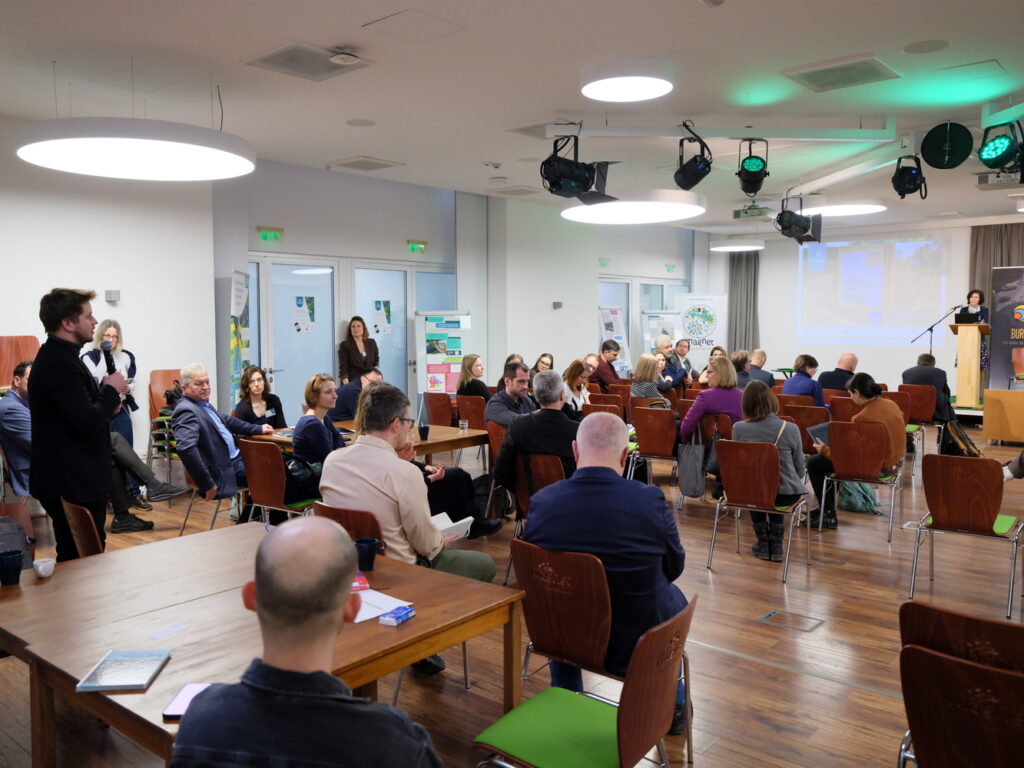
At the UPSURGE project’s final conference on 6 February 2026, several Hungarian initiatives focusing on Nature‑Based Solutions took the stage. Key topics such as water retention, biodiversity enhancement, and participatory planning were explored through an interactive workshop and a dynamic panel discussion.
The event was fully recorded, and the conference videos are available in multiple segments, offering an accessible way to revisit the discussions and gain insight into current directions in sustainable urban development:
Watch the footage in Hungarian on YouTube.
Conference Background and Objectives
On 6 February 2026, BURST Nonprofit Ltd., coordinator of the Hungarian Nature-Based Solutions Network (TeAM HUb – Nature-Based Solutions Hungary Hub), organized the final conference of the UPSURGE project at the MagNet Community House in Budapest.
The event served as a knowledge-sharing and networking platform among Hungarian partners of international and directly managed EU-funded projects promoting Nature-Based Solutions (NBS). More than 90 participants attended, representing over 20 different projects. They presented practical experiences, implementation results, and openly discussed remaining challenges and future tasks.
In her opening speech, Mónika Németh, Managing Director of BURST and coordinator of TeAM HUb, highlighted that directly managed EU programmes — such as Horizon, LIFE, Interreg, URBACT, the European Urban Initiative (EUI), and Erasmus+ — typically do not finance large-scale, high-visibility infrastructure investments. Instead, they provide crucial space for:
- experimentation and piloting,
- in-depth analytical and exploratory work,
- learning from international best practices,
- and building strong local and transnational partnerships.
When embedded in a strategic framework and followed by conscious scaling efforts, these projects significantly contribute to ensuring that larger future investments are implemented with a more progressive mindset, higher technical quality, and stronger environmental and social benefits. This experimentation and learning dimension is particularly vital in the context of climate change adaptation.
UPSURGE in Budapest’s 18th District: Implementation Results
The Hungarian implementation partner of the UPSURGE project was the Municipality of Budapest’s 18th District (Pestszentlőrinc–Pestszentimre).
On behalf of the district, Deputy Mayor Péter Körös presented the achieved results. Within the framework of the project:
- 58 rain gardens were created,
- gravel-based permeable parking areas were developed,
- and green façades were installed.
The primary objective was to retain stormwater locally in order to reduce pressure on the sewer system.
Because these solutions involve relatively new technological approaches in Hungary, the implemented developments function as a “living laboratory.” One of the main challenges was integrating these Nature-Based Solutions into existing municipal maintenance and urban operation practices.
Éva Beleznay, senior expert of the 18th District, described the interventions as mosaic-like, “mini-acupuncture” interventions in the urban fabric. She emphasized that practical experience confirms that Nature-Based Solutions generally require lower maintenance compared to conventional grey infrastructure.
A strong emphasis was placed on knowledge transfer and awareness-raising among residents. Communication and educational activities included:
- on-site information boards,
- public lectures and workshops,
- longer publications and informational materials,
- infographics,
- and targeted engagement activities for children.
Reaching children was considered especially important, as they can indirectly influence parents and contribute to long-term mindset change.
Thematic Sessions: Ten Projects, Five Focus Areas
The second part of the conference featured plenary mini-presentations followed by workshop discussions across five thematic areas:
- Municipal stormwater management
- Urban biodiversity
- Climate adaptation in small settlements and rural landscapes
- Urban climate adaptation
- Supportive policy and development environments, including capacity building
Ten Hungarian project representatives presented domestic results of projects that either implement Nature-Based Solutions or support their broader uptake.
Key Messages from Project Presentations and Workshops
Integrated Green-Blue and Grey Infrastructure
In urban environments, stormwater retention can only function effectively when green-blue infrastructure (GBI) is combined with traditional grey infrastructure systems.
Interdisciplinary Cooperation
Effective implementation requires the involvement of multiple professional fields — landscape architects, civil engineers, utility experts, universities, social scientists, and conservation specialists. The most successful solutions emerge from interdisciplinary working groups integrating technical, social, and ecological knowledge.
Partnership with Utilities and Authorities
Involving public service providers and regulatory authorities as partners facilitates changes in regulatory frameworks and operational practices. These actors can become stakeholders in innovation if properly engaged.
From Local Interventions to Strategic Planning
Instead of isolated, point-based local interventions, a more strategic and comprehensive approach is required. This should be based on:
- settlement-level data analysis,
- runoff modelling,
- identification of vulnerable areas,
- integration of local experiential knowledge,
- and development of action plans accordingly.
Monitoring and Data Systems
Reliable, standardized measurement systems are essential. This includes:
- predictable and robust measuring instruments (e.g., flow meters, sensors),
- standardized monitoring frameworks,
- and proper protection of installed equipment.
Monitoring serves not only to assess baseline conditions but also to evaluate impacts and provide feedback. Demonstrating measurable results strengthens public acceptance and supports residents’ identification with implemented measures.
Community Engagement as a Cornerstone
Engaging residents is a key success factor and simultaneously supports knowledge transfer and mindset change. Projects used a diverse and creative toolkit, including:
- garden visits and thematic walks,
- drawing competitions,
- community planting events,
- workshops and mentoring,
- community cooking events,
- kindergarten and school programmes,
- gamification approaches.
In smaller settlements and tight-knit communities, these forms of engagement can be even more direct and effective.
Energy invested in community involvement pays off: residents become more receptive, appreciative, and understanding of what is implemented — and why certain measures are not.
Inclusion of Private and Peri-Urban Areas
Climate and environmental sustainability work must include:
- peri-urban and rural areas to prevent uncontrolled urban sprawl,
- preservation of green spaces,
- and private properties.
The spread of paved surfaces and artificial turf gardens can only be countered through incentive schemes and awareness programmes targeting residents.
Peer Learning
Best practices spread most effectively “from neighbour to neighbour” and “from settlement to settlement.” Mutual learning not only accelerates the adoption of good solutions but also helps avoid repeating mistakes.
Small Budgets, Significant Impact
Even modest starting budgets can produce meaningful environmental and social impact. For example, in the city of Veszprém, an urban beekeeping programme was launched with an initial budget of approximately 1 million HUF (around €2,500).
At the same time, many municipalities require substantial capacity building and technical assistance to design and implement more complex, large-scale projects. County-level governments can play an important coordinating and integrative role in this process.
From Projects to Processes
A key insight emphasized during discussions: nature does not operate in project cycles but in continuous processes. Governance and funding approaches should increasingly reflect this long-term, process-oriented logic.
Policy-Level Integration
Cross-sectoral coordination is necessary not only at project level but also at policy level. This represents not merely a matter of awareness-raising but a genuine paradigm shift.
Hungary’s KEHOP Plus call for municipal green-blue infrastructure development represents an attempt to operationalize such integration by aligning funding structures with the required mindset shift — accelerating change at an unprecedented scale nationally.
Regional Climate Data Cooperation
The Central and Eastern European region shares similar climate impacts, yet responses are based on different data systems and governance levels. Cross-border regional climate databases, vulnerability assessments, and climate models are crucial for better risk identification and more effective policy interventions.
Municipalities would significantly benefit from centrally available high-resolution spatial datasets and surface models that can be used directly in project planning.
Panel Discussion I: Community Engagement in Practice
Moderated by Balázs Kozák, senior expert at BURST, the first panel focused on the opportunities and challenges of social engagement processes.
Participants:
- Sára Baksa-Valánszki, Head of Department, Budapest District 18
- Ákos Harmat, Deputy Mayor of Érd
- Csaba Alvári, Chief Architect of Jászberény
A key insight was that community engagement should begin with smaller-scale, tangible developments connected to locally relevant issues. Such projects generate higher interest and stronger commitment.
Direct EU and international projects provide added value by enabling long-term, in-depth participatory processes and experimentation with innovative engagement methods. These go beyond simple consultation and enable genuine participation, strengthening the legitimacy of municipal plans and interventions.
Social media is useful for communication and awareness-raising, but less suitable for structured feedback collection, as vocal minorities are often overrepresented.
Panelists highlighted:
- the importance of internal knowledge transfer within municipal administrations,
- engagement of local institutions, NGOs, kindergartens, and schools,
- and the necessity of skilled facilitators.
According to Sára Baksa-Valánszki, community consultation must be structured around clearly defined questions. While 100% consensus is never achievable, final decisions must never contradict the clearly expressed will of residents.
Panel Discussion II: Future EU Funding Opportunities
The second panel explored future EU funding opportunities supporting Nature-Based Solutions.
Moderator:
- Ferenc Albert Szigeti, senior expert at BURST
Panelists:
- Dr. Ildikó Réka Báthoryné Nagy, Head of the National URBACT Point and EUI Contact Point
- Beáta Iványiné Batta, Head of Department, Managing Authority of KEHOP Plus
- Eszter Héjj, Managing Director, Grants Europe Consulting
In 2026, several funding instruments contribute to the implementation of Nature-Based Solutions:
- URBACT supports participatory integrated action planning and pilot activities within international city networks.
- European Urban Initiative supports larger-scale innovative urban investments, including climate adaptation and NBS, as well as City-to-City exchanges and Peer Reviews.
- LIFE Programme supports not only conservation but also climate adaptation, mitigation, innovative governance models, and awareness-raising activities.
Direct EU programmes often lay the groundwork for larger-scale investments financed from national operational programmes. Currently, KEHOP Plus provides an excellent opportunity for scaling up municipal green-blue infrastructure projects. However, this funding scheme requires a fundamentally different planning mindset compared to earlier Territorial and Settlement Development Operational Programme (TOP Plus) calls.
The preliminary evaluation by expert planning juries plays an important role in shaping high-quality proposals, and incorporating their recommendations is essential.
Closing Reflections from Participants
Selected quotes from participant feedback:
- “It was our dream to connect with stakeholders involved in green-blue infrastructure development — this conference made it possible.”
- “It was inspiring to see so many beautiful projects on this topic.”
- “We would like to visit these developments in person.”
- “We are behind internationally, but we intend to catch up. The TeAM HUb is an excellent platform — it should continue and expand cooperation.”
- “The KEHOP Plus call represents a paradigm shift: challenging for everyone, but an opportunity to step up.”
- “This spirit and expert mindset should become part of everyday practice, not remain limited to a narrow circle.”
- “Continuous development is necessary — there is always a better solution than the one currently applied.”
- “The regulatory framework also needs further development.”
- “More communication is needed in rural areas.”
Read the Final Conference Report in Hungarian
Acknowledgements and Contact
Photos from the event are available for download and may be used with credit to photographer Attila Glázer.
The organizers thank all participants for their inspiring contributions and active discussions, and encourage continued collaboration beyond the conference.
For further cooperation through the TeAM HUb network:
BURST Nonprofit Ltd.
www.burstgroup.eu
teamhub@burstgroup.eu