
A conversation with Gábor Soóki-Tóth, housing and urban-development expert, on why affordable housing is now a European question — and what it takes to make solutions outlast the funding.
Housing is an old story, but the pressure is new in scale and speed. Across Europe, cities are discovering that housing is not a side topic: it sits at the intersection of labour markets, wellbeing, climate and institutional capacity. In Budapest — like in many European cities — an energy crisis has deepened a long-running housing affordability crisis, exposing new social groups to energy poverty and housing insecurity, while the social-housing sector has been marginal, shrinking and in disrepair for decades.
The AHA Budapest – Affordable Housing for All project, co-funded by the European Urban Initiative and part of the New European Bauhaus, tries to answer that challenge by treating affordable housing not as a one-off programme but as a system: the near-zero-energy conversion of an unused public building into social housing, new and flexible affordable-housing solutions, and early social and energy interventions built on a unique early-warning approach — partnerships that could, in theory, outlive the grant.
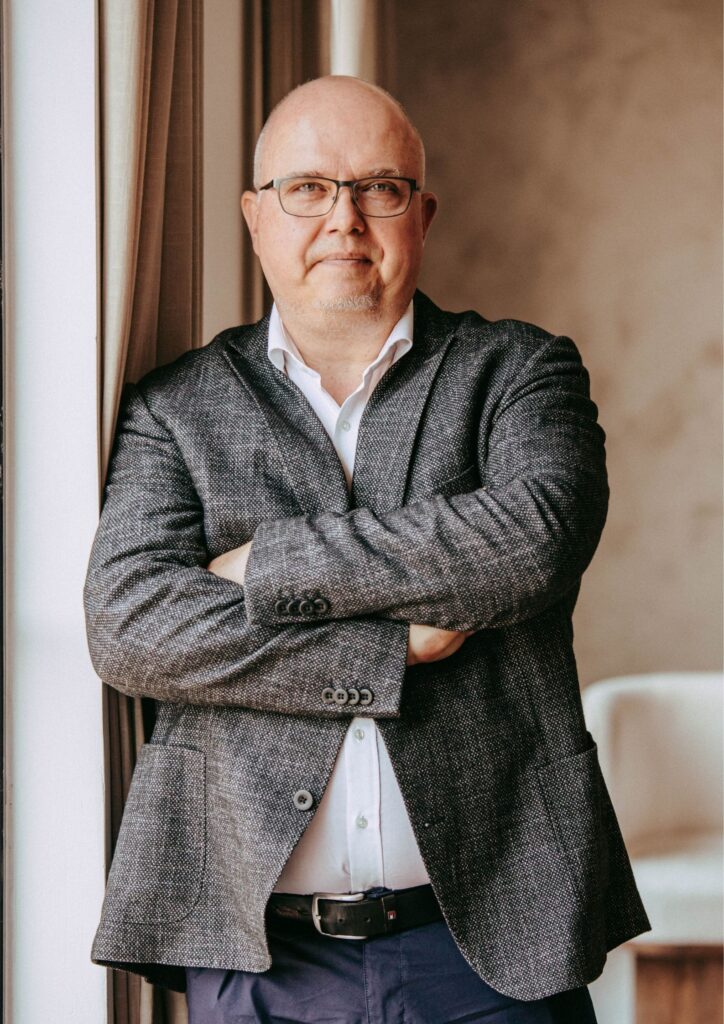
Within the consortium, BURST leads the work on the model’s financial and operational sustainability and coordinates the project’s Sustainability Working Group. Gábor Soóki-Tóth joined BURST’s AHA project team in September 2025, contributing chiefly to that Sustainability Working Group. We spoke with him about what feels viable, what feels fragile, and where the real bottlenecks lie.
A market-and-academia lens
Gábor’s way of thinking is worth a brief word, because it shapes his reading of AHA. His career moves between real-estate market analysis and housing and urban-policy thinking — between the market and academia — with a long-standing fascination for housing systems, from Dutch institutional models to Vienna’s rehabilitation tradition.
Gábor Soóki-Tóth: “I’m much more the analyst-strategist type than the designer architect. I like to understand what is behind things — the framework, the logic, how you make a system function. Two ‘source regions’ shaped my thinking: the Dutch model — I even wrote about how the 1901 Housing Act built their non-profit system — and Vienna’s rehabilitation tradition. AHA sits exactly at the meeting point of the two things that interest me: the physical side, re-using and transforming existing buildings, and modelling housing pathways for different income groups — what policy and regulatory mechanisms can support people whose work is essential for society, but whose income no longer buys the same comfort.”
What is “innovative” here — really?
When you first looked at AHA, what made you say: this is worth joining?
Gábor Soóki-Tóth: “The first thing is a very strong organisational innovation. AHA creates new working units, and the real question is whether that can be made sustainable inside the current metropolitan bureaucracy. I have questions — but that is genuinely new. The second is the channelling and connecting of information. That is really the essence. The early-warning approach has models abroad, there are ‘pre-images’ of it — but the key is how we weave it into our own reality. And then there is a kind of thinking innovation: even where measurement is uncertain, bringing a cost-benefit logic into decision-preparation, making it visible where the system hurts, and looking at alternatives not only from 10,000 metres but also in the details.”
Importing models vs. living them
The conversation turns most candid on context. Hungary’s challenges, Gábor argues, are not only technical but cultural: cooperation, incentives, institutional habits.
You’ve worked with Dutch and Austrian reference points. What happens when we try to “import” ideas into Budapest?
Gábor Soóki-Tóth: “First: if you actually live in those countries, you see it is not perfect there either. The neighbour’s grass is always greener, but reality is more complex. Still, they are great sources of inspiration — you can see the structures, even if the details will not work one-to-one. And I think we have a kind of ‘genetic handicap’: cooperation is hard for us, and our creativity runs in a strange direction — we love clever workarounds instead of building real solutions. We are brilliant at explaining why something won’t work, and less brilliant at coming together to make it work anyway. But a lot depends on individuals. If you build good alliances, institutional frameworks become less obstructive — you can jump over them and still push something forward.”
Bureaucracy, silos and continuity
When you look at decision-making structures in Hungary, what feels like the main bottleneck for long-term housing innovation?
Gábor Soóki-Tóth: “Honestly, I don’t see strong systemic capacity — that’s the problem. And worse, these systems socialise people: you enter an institution and it shapes you in its own image. Hungarian public administration is very silo-based, and people inside suffer from it too. Throughout my career I worked with smaller, more transparent, more horizontal organisations — you could talk things through. In big bureaucracies it is harder, and we lack coherent management.”
So where is the realistic hope? If systems are fragile, what actually moves things forward?
Gábor Soóki-Tóth: “There are committed people, and I have really good experiences — sometimes one person with a correct, predictable, pragmatic approach can unblock years of stuck processes. But the risk is obvious: if it is only a person, it evaporates when they leave. That is why institutionalisation matters. The biggest tragedy is when we spend significant funding and then, when the money closes, everything crumbles into dust — because the system lacks continuity across political cycles. So the task is to find actors whose interests can be harmonised, and then lock in what works so the viable elements can continue.”
Housing is no longer “national only” — it’s European now
You’ve said housing has become a “hot topic”. What’s shifting in the wider context — nationally and at EU level?
Gábor Soóki-Tóth: “We can see movement. Some districts built social rental housing in earlier periods; others are only now starting. I worked on a small housing-strategy pilot in District III that later became a mini project with a private actor, and now, even at metropolitan level, developers contributing rental housing is beginning to appear. Still pilot phase — but the stones rub against each other, and the river moves forward. At EU level, housing used to be treated as ‘not our competence, a national issue.’ Now it turns out it is interconnected with cities, segregation, economic function, labour markets, cost of living and quality of life — so the housing question finally enters the picture. There will be multiple models, good and bad. Looking back 100–150 years, you see how different forces produced different answers; in the Netherlands the big scale came with post-war reconstruction and a stronger state role. There are parallels, even if the contexts differ.”
Making capital work: from “dead capital” to mobility
What’s a structural lever Hungary underuses in housing?
Gábor Soóki-Tóth: “I strongly believe we should make capital work more. Households keeping some 90% of their savings locked in a single housing asset — ‘dead capital’ — is not necessarily good at that level for social mobility. Changing it needs many tools at once: regulation, the financing environment, and now climate pressures, crisis management, even geopolitical stress — the war next door changes our mental models too. All of this is part of resilience.”
Partnerships: “does it even hit the attention threshold?”
AHA puts a lot of weight on public–private cooperation. Gábor frames it not as ideology but as incentives and design.
What makes these partnerships succeed in practice, not in theory?
Gábor Soóki-Tóth: “First, understand whether — through their own glasses — this issue even hits the involved partner’s attention threshold. Second, understand their interests, and whether we can offer a value proposition where they also see a positive return. Then, can we create ‘anchors’, or something like a petri dish, where several actors meet and form partnerships? It is easy for a private actor to say housing is the state’s responsibility, but everyone knows the state cannot be the only initiator. Sometimes two or three actors see a shared opportunity and agree to share the burden — and suddenly it can even make business sense.
“Philanthropy can play a role, but patronage makes you dependent. I believe in models that run on normal business logic, and then we regulate who benefits. The patron shouldn’t ‘maintain the system’; they should help the beneficiaries, while the system itself runs as a robust mechanism. We already do this with subsidised loan schemes that enable banks to participate — it is neither good nor bad, it is a tool. But some groups can’t or won’t take on long-term debt, so we need other pathways too. And I’d like the ideological debates to evaporate, because they lead nowhere.”
A “robust system” and the survival game
What does a sustainable affordable-housing model look like, in your language?
Gábor Soóki-Tóth: “Society has many actors, and we cannot treat everyone as a unique exception — a system has to be robust. There will always be people who fall out; there is no perfect salvation for everyone. The question is whether we can build something that works at scale while still responding to individual needs. I sometimes think of it like ‘Industry 4.0’: mass production, but still personalised — the process is built, yet parameters can change. We are not making machines, we are dealing with lives, but the idea is similar. The system should be robust enough that when someone arrives with a very specific situation, they can find a path — adapting a little to fit through, without having to violently reshape their life.”
“If the math doesn’t work…”
Many will say: “the math doesn’t work.” How do you respond?
Gábor Soóki-Tóth: “Exactly — many will say the math doesn’t work. And then the key question is: ok, but why doesn’t it work? Which element is the bottleneck — financing, regulation, cost structure, risk, operations, targeting? And what can we actually influence? The point is not to stop, but to diagnose, and then decide where intervention makes sense and where we accept trade-offs because other benefits make it worthwhile.”
What remains after 26 homes
AHA’s flagship is the near-zero-energy conversion of an unused public building — an abandoned school in Újpest becoming 26 energy-efficient affordable homes. But Gábor sees the real result beyond the building.
Beyond delivering 26 homes, what would be a realistic and meaningful outcome by the end of the project?
Gábor Soóki-Tóth: “The institutional-development part. That it becomes obvious to the actors that the housing office is worth maintaining; that the housing agency can be scaled to a measurable level; that partners — companies, municipal service providers — see the benefit of joining. And that it enters public understanding that ‘guaranteed housing’ can exist, so that as a landlord you can also place trust in this story. On replication, I’d be cautious about converting many school buildings — we may need them again if children return — so it is more about temporary uses and smarter transitions. But could we trigger creative re-use of privately owned brownfield assets, instead of only demolition and rebuild? I’m interested in modular construction and more efficient technologies. And there is a concept I love: a ‘garden city in the inner city’ — high-quality temporary living environments in brownfield areas for 15–20 years, later transformed into denser urban districts. Those are the long arcs that excite me.”
About the project
AHA Budapest – Affordable Housing for All develops an integrated, modular service model to reposition social housing as a financially stable, green and aesthetic sector — attractive to private investors and therefore scalable. It is co-funded by the European Urban Initiative under the New European Bauhaus, led by the Municipality of Budapest with a consortium of partners. BURST is responsible for the model’s financial and operational sustainability and scalability, and coordinates the Sustainability Working Group.
Timeline: the project’s core activities run for roughly another year, with the horizontal activities continuing for a further six months, until February 2028.